CIBC Commercial Banking · via Deloitte · 2022
Commercial onboarding, from 3–5 weeks to under 7 days.
As the sole product designer, I designed CIBC's online onboarding portal for commercial clients. It replaced paper forms and endless emails with one guided place to share information, upload documents and track progress.
- Role
- Sole Product Designer, via Deloitte
- Team
- CIBC product lead, UX design lead, engineering
- Users
- Commercial clients (CFOs, controllers) and onboarding specialists
- Platform
- Desktop web portal
- <7 daysto onboard a commercial client, down from 3–5 weeks
- 6CIBC clients in feedback sessions
- 80%rated the portal easy, and 20% super easy
- 35+pieces of feedback turned into a prioritized list
The problem
Paperwork, back-and-forth, and no idea what happens next.
Opening commercial accounts meant paper forms, unclear document requirements and weeks of emails. Clients often gave the same information more than once, and had no way to see where their request stood.
- Pain pointPhysical formsPaper forms and documents for every new account or service.
- Pain pointUnclear requirementsConfusion about which documents and signing authorities were needed.
- Pain pointRepeated informationSharing the same details again for each new request.
- Pain pointNo transparencyNo way to track the status of an onboarding request.
Persona: Rob, CFO of a prospective client
“I want a seamless, auto-pilot onboarding experience that lets me be as hands-off as possible.”
The solution
One portal, eight clear sections, zero guesswork.
Clients get an email invite, set a password, and land on an overview of their whole onboarding journey. Information the onboarding specialist already collected is pre-filled, so clients review it instead of retyping it.
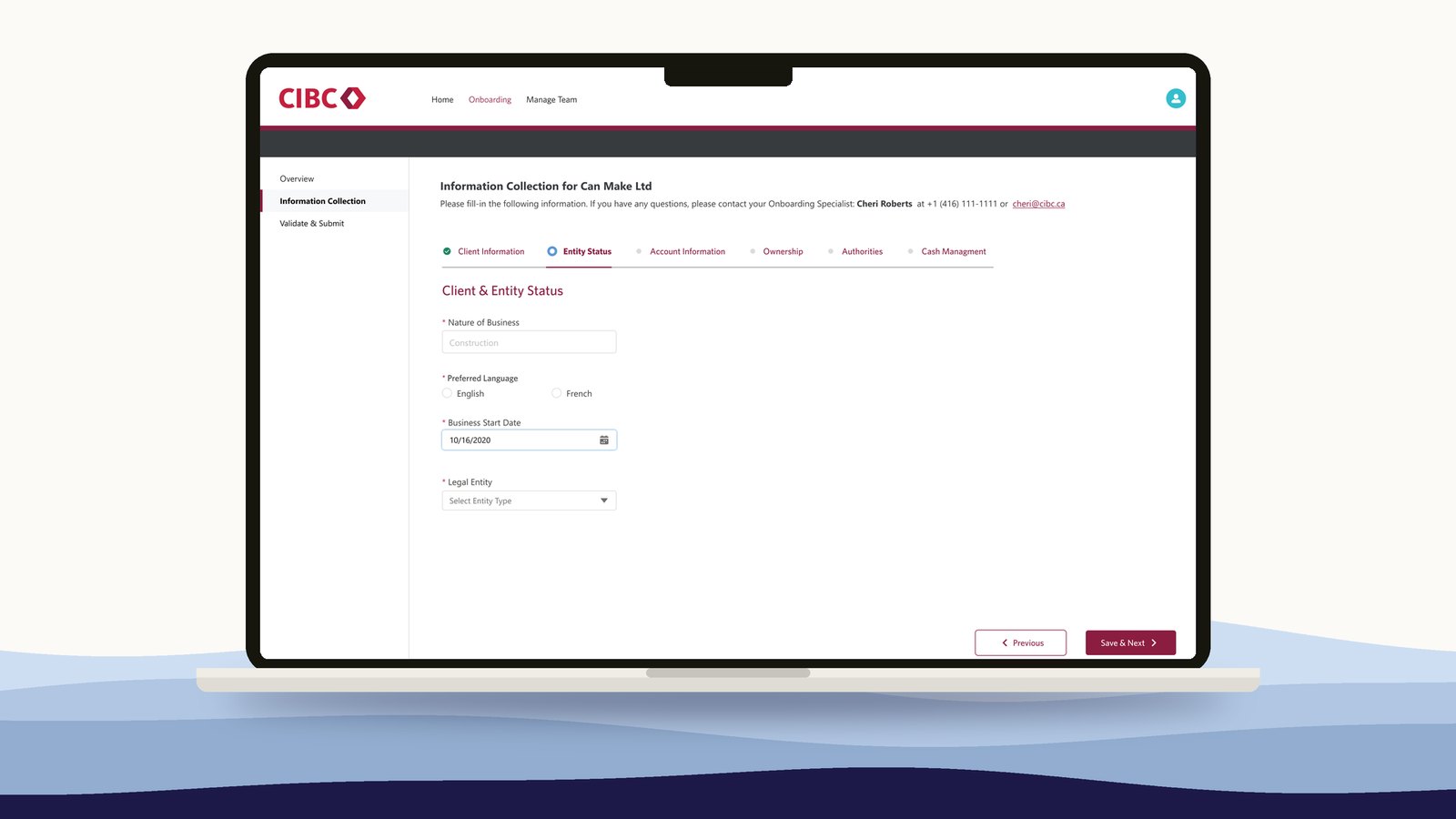
- Review, don't retypeClients confirm pre-filled details, or request a change in one click.
- Upload in placeDocuments like articles of incorporation are attached right where they are asked for.
- Many accounts, one flowAdd details for many accounts one at a time, with clear “1 of 3” progress.
- Always know the statusAn overview tracks every stage, from information collection to training.
The journey it supports
- 1Origination
- 2Information gathering
- 3Validation and account opening
- 4KYC/AML and product fulfilment
- 5Post account creation
How we got there…
Map it, design it, ask the clients.
01 · Understand
Started from personas and the journey.
In workshops with CIBC, we mapped the prospective client, the existing client, frontline teams and support specialists, and the five stages of onboarding. Each stage showed where paperwork and waiting piled up.
02 · Design
Designed the happy path, then every edge.
I designed the full flow, from the invite email and password setup to review and submit, plus the edge cases: errors, change requests, multiple accounts and complex ownership rules. A shared component library and spacing template kept it consistent.
03 · Validate
Moderated feedback sessions with real clients.
I moderated 60-minute sessions with 6 CIBC clients, from a church in the GTA to a client managing 24 accounts. We walked through the 8 sections one at a time, then rated ease and confidence.
- Ease80% easy80% of clients said the portal was easy, and 20% said super easy.
- Feedback35+ commentsfrom 6 one-hour sessions, turned into 23 prioritized improvements.
- Clarity33 mentionsof labels or instructions that needed to be clearer. That became the to-do list.
04 · Refine
Fixed what confused people.
“Business Start Date” meant three different things to clients: incorporation date, first business activity, or the day they opened a CIBC account. We clarified labels like this, moved instructions to the top of each page, and showed where pre-filled information came from.
What clients said
Simple, and easy to use.
“Even though I have never done this before, the onboarding portal is straightforward and easy to understand. I would feel confident to do this on my own.”
“It is nice to have a centralized portal for all of the onboarding documents. It eliminates a lot of the back and forth.”
Turning a paper process into a product? Let's talk.